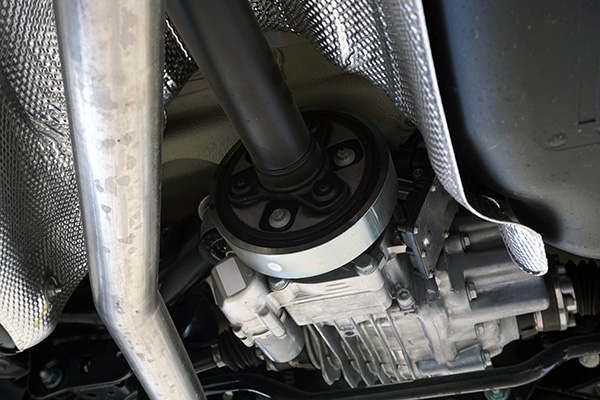
A torn CV boot does not automatically mean the whole axle is bad. Sometimes the boot has just started to split, the grease is still where it belongs, and the joint underneath is quiet and tight. In that situation, saving the original axle can make sense.
The decision changes quickly once dirt, water, and road grit get inside. By the time the joint starts clicking in turns or vibrating under acceleration, replacing only the boot may be too late. What matters isn't just the tear itself, but how long it's been open and what condition the CV joint is in now.
What Happens After a CV Boot Tears
A CV boot keeps grease packed around the constant velocity joint while sealing out contamination. The joint has to transfer engine power while changing angles as the suspension moves and, on the outer joint, as the wheels steer. That grease protects the bearings and machined surfaces inside.
Once the boot splits, centrifugal force starts throwing grease outward. You may see thick grease on the inside of the wheel, strut, control arm, or splash shield. At the same time, moisture and abrasive dirt can work their way into the joint. The longer that continues, the less likely a new boot alone will be a lasting repair.
When a CV Boot Repair Still Makes Sense
A boot replacement is most effective when you catch the damage early. The joint should still move freely without clicking, binding, or excessive play, and there should be enough clean grease left inside that the joint has not been running dry.
During an inspection, we look closely at the grease and the joint itself. If the grease is still clean and the internal parts feel good after you remove and inspect the axle, you can clean out the old grease, repack the joint, and install a new boot. Keeping a good original axle can be worthwhile, especially when the alternative is a lower-quality replacement part.
Clicking in Turns Usually Changes the Answer
A repeated click or snap during a tight turn is the classic sign of an outer CV joint that has developed internal wear. The sound is often easiest to hear when accelerating through a parking lot turn or making a U-turn with the steering wheel near full lock.
Once those internal grooves and bearing surfaces are worn enough to click, a new rubber boot cannot put the metal back where it was. Repacking the joint may quiet it briefly in some cases, but it does not undo the wear. At that point, replacing the axle is generally the more sensible repair.
Inner CV Joint Wear Can Show Up as Vibration
The inner joint tends to complain differently. Instead of clicking in a turn, it may cause a shudder or vibration under load. You might feel it while accelerating uphill or pulling onto a highway, then notice it fade almost immediately when you lift off the accelerator.
That symptom still needs testing because engine mounts, tires, wheels, and other drivetrain parts can create a similar feel. At our shop, we compare the vibration with throttle position, vehicle speed, axle condition, and mount movement before blaming the CV joint. Replacing an axle because the car shakes under acceleration, without confirming the source, can be an expensive mistake.
Labor and Parts Quality Affect the Decision Too
On some vehicles, replacing a boot takes nearly as much labor as removing and replacing the entire axle. The axle has to come out either way, and boot service adds cleaning, disassembly, inspection, fresh grease, new clamps, and careful reassembly. If the joint already has substantial mileage, the cost difference may be small enough that a complete axle is the better value.
That does not mean the cheapest complete axle is always the best choice. Replacement axle quality varies. A good original axle with an early boot tear may be worth saving, while a badly contaminated or noisy original joint is not. The repair decision should balance labor, joint condition, axle quality, and how long you plan to keep the vehicle.
Catching the Tear Early Gives You More Choices
CV boots often split in the folds where the damage is hard to see from the driveway. By the time grease reaches the wheel or the joint starts making noise, the tear may have been there for quite a while. Regular maintenance gives a technician a chance to spot cracking or early grease seepage before the joint has been exposed for months.
If you find a torn boot, avoiding unnecessary miles can help preserve what is left. A prompt inspection can determine whether the joint is still worth saving or whether replacing the axle will save you from paying for a boot now and an axle shortly afterward.
Get CV Boot And Axle Repair In Eugene, OR, With Small World Auto Repair
If you have found a torn CV boot or started hearing clicking or feeling vibration under acceleration, Small World Auto Repair in Eugene, OR, can check the joint condition, grease contamination, axle play, and remaining boots before recommending the repair.
Contact us to schedule CV axle service and find out whether your original axle can still be saved or is ready for replacement.